Lume
Most students already have the tools they need to talk to one another. They have group chats for planning, Instagram for sharing pictures, Discord for club life, and email for a miscellaneous of other things. What many lack is a place that is public enough for discovering people and quiet enough to actually follow conversation.
That is the niche Lume exists to fill.
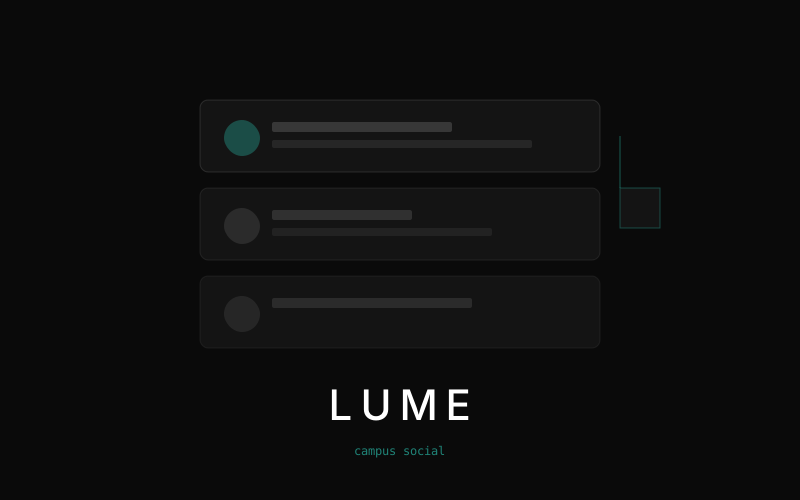
Lume is an app built for campus communities. It has a posting feed, threaded comments, user profiles and DMs, and is designed to feel familiar without being overwhelming. You can open the app, see what people around you are talking about, respond if you want, and close the app. It isn't trying to do everything; it's trying to be the layer where campus life happens.
Why build another app?
Students certainly don't have trouble communicating.
The problem is that the student communication tools are fragmented. An announcement for your club is in one place. A question about homework is in another. A photo from that night's event is posted in a third. In the long run, the people who share a campus with you become harder, not easier, to find. Not lost, but scattered.
Lume has taken one approach to this: what if the unit of student social life is a simple post — text, maybe with an image — that anyone can reply to, and live on a profile that lists every single thing you have posted in order so you can take a look back at it next to your bio.
That's the model Threads has made effective for text-based interactions. Lume is trying to reapply that model to the context where it has the most resonance: a tightly bounded community of classmates, club members, and friends that you know in real life and are, or soon will be, constantly seeing in person.
What Lume is, really
Under the hood, Lume is a feed of posts combined with a social graph.
When you create a new account, you choose a username and create a basic profile. You give yourself a display name, a photo, and a short bio. After that, you can start posting threads of text and images, and other people will be able to reply, like, and follow you so they see what you post.
The feed has two views. You can see the posts from all of campus ("For You"), or you can select to only see the posts from people you are following ("Following"). The distinction between the two is important when talking about school, because you may want to browse what's happening on campus in general, but day-to-day your primary focus will likely be on the people closest to you.
Profiles are standard for social products. You can see all of a person's posts and comments, when they joined, and decide if you want to follow them. A search feature lets you quickly find people you might have met, perhaps briefly at an event or during a lecture, by their username.
Direct messages complement the feed. You can DM people you are acquainted with; message requests give you a buffer against the spam that often floods any public platform. But the underlying principle that the developers hope to uphold is one of transparency without intrusion.
Designed for student interaction
Student social life has a unique rhythm. You are constantly encountering people informally, through classes, clubs, events. But then you need ways to keep in touch that are both personal and manageable. Students have naturally converged on existing platforms, which, when taken to their logical extremes, lack something. Group chats don't scale. Mass social platforms are designed for constant engagement rather than simple interaction. Email, while functional for bureaucracy, is culturally sterile.
Lume is based on observations of what students are looking for.
- Findability: When you meet someone on campus, it's not always convenient or even appropriate to exchange phone numbers immediately, or to guess if they are on the correct Discord server. Usernames, search, and public profiles solve this problem efficiently.
- Conversation, not broadcasting: Posts and threaded replies give people a space to develop ideas, have discussions, and react to things without the context shifting every few seconds. A question about a midterm or debate about a class project can play out in one organized thread rather than across three different apps.
- Control over visibility: Private accounts and messaging settings allow users to decide how public they want their profile to be. This isn't a privacy setting in the sense of hiding sensitive data; rather, it gives students more control over who they interact with online and how.
- A baseline for trust: Verified badges are issued via a short, one-time verification code (rather than an application process), giving official organizations and club leaders a simple way to distinguish themselves from imposter accounts.
- Basic respect: Offensive language in posts and messages are automatically masked by default (with an option to view), creating a more comfortable environment for students.
What we're not building
Lume is not intended to replace the majority of communication tools students currently use. It will not be scheduling classes, hosting documents, or managing club logistics.
Nor is Lume trying to keep students engaged with the app for the longest possible time. It's not filled with infinite scrolling, dopamine-triggering notifications, or other engagement tactics; the interface is intentionally plain, with dark backgrounds, simple fonts, and familiar navigation. The goal is that students log in, see what's up, and then get back to real life.
Intentionally a small network
There is something fundamentally different about building social software for a specific community versus the entire world.
On a smaller network, discovering other people happens at a human pace. You aren't drowned out by celebrities or brands competing for attention in your feed. When you post, the odds are high that the people who see it could plausibly be walking past you on the sidewalk tomorrow. When you choose to follow someone, it has meaning.
This is the world that Lume has been built for: not the internet on a campus, but a school — a small network of people sharing a physical space and a specific moment in time.
The path forward
Lume is currently live and growing. All your account data, including your profile and posts, is saved to the cloud so it is accessible from any device. The product will continue to evolve, but the direction remains consistent: making it simpler for students to discover one another, say things that matter, and stay connected without sacrificing control of their attention or inboxes.
Lume is available at lume.luminarc.ai.